
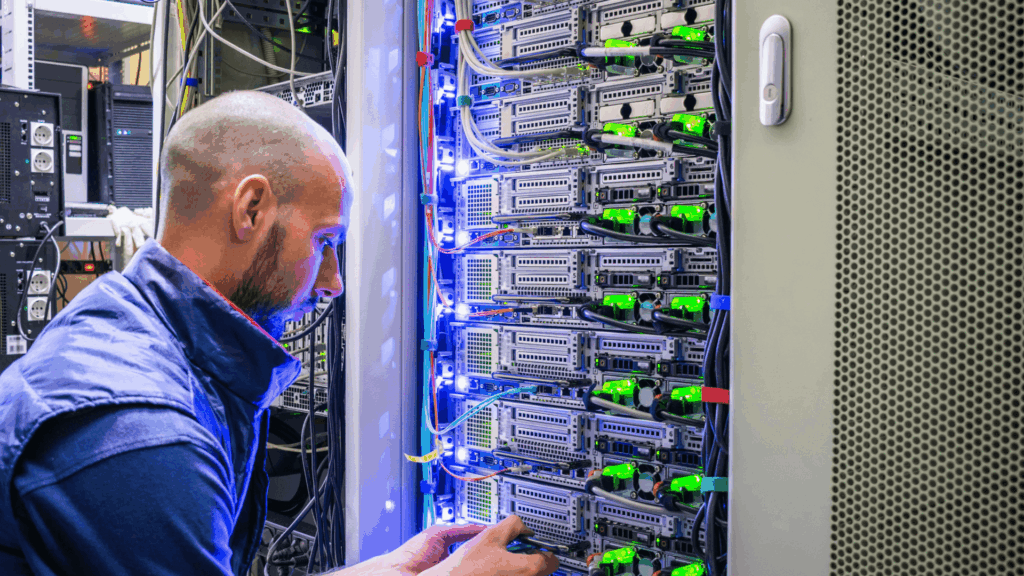
Essential Server Rack Configuration Tips for Cost-Efficiency
Don’t let an inefficient server rack compromise your operations. An optimized server rack power setup is crucial for preventing inefficiencies and saving costs, whether managing a single setup or a complex installation. By following these expert tips, you can ensure your server rack operates smoothly:
- Accurately Assess Power Requirements
- Choose Appropriate Equipment
- Construct a Robust Power Pathway
- Implement Advanced Monitoring Solutions
We’ll delve into each of these strategies, ending with a guide to help you select the ideal Power Distribution Unit (PDU) for your needs.
Assessing Power Needs
Before configuring your server rack, it’s crucial to understand the power demand of your equipment. Without this insight, you risk inefficiencies and financial losses. Begin by examining the power source and ensuring your rack PDU can supply the necessary amount of power. Here’s how you can determine the best rPDU setup:
- Refer to each equipment manual for amperage or voltage details, then aggregate these for total power consumption.
- Allocate an additional 20% to accommodate future expansions.
- Define redundancy objectives to decide on single or dual power feeds.
- Measure the available voltage and phase at your rack location.
It is also vital that your rPDU complements the physical demands of your server rack. Look for features such as matching receptacles and plugs, sufficient internal space, adaptable mounting options, and potentially intelligent capabilities like remote management and environmental sensors.
Selecting the Right Equipment
A well-designed server rack setup goes beyond power requirements, ensuring efficient and safe energy distribution. Reliable backup power solutions, like Uninterruptible Power Supplies (UPS) and PDUs, are indispensable for continuity. These components safeguard your server rack from power interruptions, minimizing costly downtimes.
Understanding UPS Systems
UPS systems provide critical backup during power outages, bridging the gap between the loss of primary power and generator engagement. Ensure your UPS is adequately sized and capable of meeting both immediate and future power demands.
Importance of Rack PDUs
Rack PDUs are essential for delivering specific energy quantities to each device within your server rack. Beyond power delivery, they offer advanced features such as power consumption monitoring and management for connected devices, aiding in efficient energy usage and operational visibility.
- Basic Rack PDU: Provides dependable power distribution for server racks.
- Metered Rack PDU: Offers onsite power metrics, ideal for secure environments.
- Monitored Rack PDU: Delivers power usage data both locally and remotely, perfect for high-density and remote-access data centers.
- Switched Rack PDU: Allows remote access and outlet control, suited for large data centers with distributed IT spaces.
Geist PDUs adapt to your specific requirements, offering customizable options to seamlessly integrate with your server rack setup. If you require guidance in selecting the right Geist rPDU, our experts are here to assist.
Utilizing Rackmount Automatic Transfer Switches
Incorporating an Automatic Transfer Switch (ATS) ensures that your server rack remains operational by quickly switching between power sources during main power failures. This seamless transition prevents operational disruptions due to power disturbances.
The Role of Monitoring Equipment
To maximize your server rack’s performance, ongoing monitoring is vital. Power monitoring tools provide insights into power usage, helping to avert overloads and anticipate future capacity requirements.
Establishing a Dependable Power Pathway
For optimal performance, all components within your power setup must work harmoniously. Creating redundant power paths, such as A-side and B-side paths, enhances system reliability and allows maintenance without operational interruptions. Load balancing between PDUs is critical to ensure adequate capacity and prevent system failures.
Ensure your server racks are organized to encourage airflow and cooling efficiency. Vertical Geist PDUs are particularly beneficial in this regard, as they maximize outlet access while preserving space for equipment expansion.
Frequently Asked Questions on Server Rack Setup
How can I ensure my server rack power setup is effective?
An efficient setup provides steady power while preventing overloading. Incorporating load balancing, real-time monitoring, and redundancy are key indicators of an effective system.
What is the significance of load balancing in PDUs?
Load balancing ensures no single circuit is overburdened, promoting efficiency and supporting high-density operations.
How do environmental factors influence rack power systems?
Environmental conditions like heat and humidity directly affect equipment efficiency and lifespan. Integrating environmental sensors aids in proactively managing these factors.
What type of PDUs work best for my server rack layout?
Vertical PDUs are typically better for high-density setups due to space savings and enhanced airflow, while horizontal PDUs suit racks with fewer equipment needs.
Can I access my PDUs and UPS systems remotely?
Yes, with intelligent PDUs and UPS units, remote monitoring is possible, providing real-time data to support informed decision-making.
Need Help Choosing a Rack PDU? Download Our Selection Guide
Creating a robust server rack setup involves more than selecting the rack itself. Efficient operation relies on proper power management, including the right UPS systems and PDUs. For guidance on selecting the ideal PDU, download our free selection guide.
Contact us for expert advice at 469.467.4000 and we’ll help you find the right solution.